
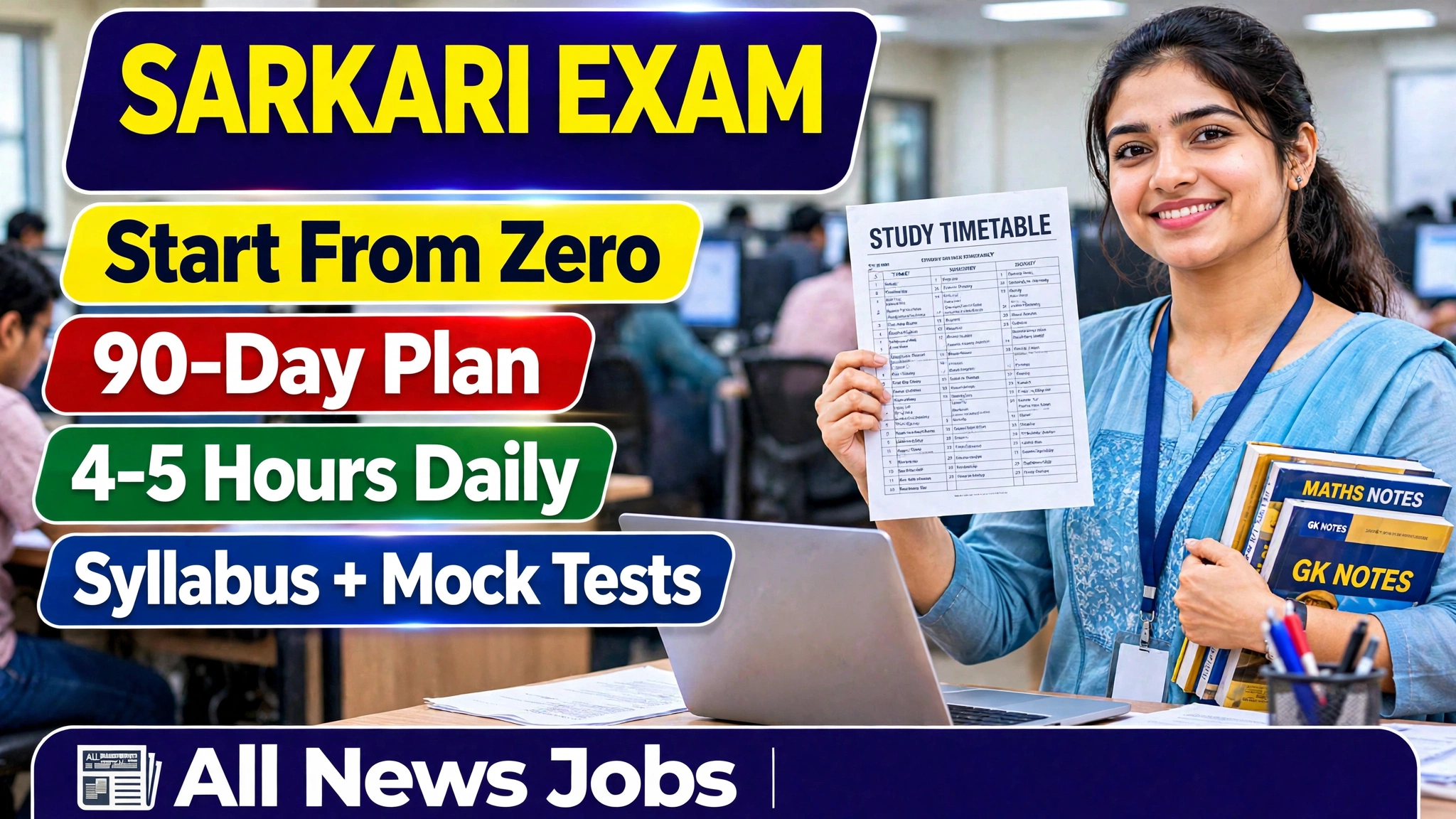
If You Are Wondering How To Start Sarkari Exam Preparation From Zero, The First Thing To Know Is That It Feels Overwhelming, And That Feeling Is The Reason Most Candidates Never Actually Start. They Collect Books, Download Syllabuses, Join Groups And Watch Videos About Toppers, And After A Month They Have A Shelf Full Of Material And No Real Progress To Show For It. The Problem Is Not A Lack Of Effort Or Intelligence. It Is The Absence Of A Plan That Tells The Candidate What To Study Today, How Long To Study It For, And How To Know Whether The Study Is Working. This Article Gives That Plan In Ninety Days, And It Is Written For A Candidate Who Is Starting From Nothing, With No Coaching, No Expensive Course And No Previous Attempt Behind Them.
Sarkari Exam Preparation : 90-Day Plan
From Zero To Exam-Ready In 90 Days
AllNewsJobs.com
- The Most Common Mistake A Beginner Makes Is To Open A Book On The First Day And Start Reading From Page One. The Right First Step Is Slower And Far More Useful.
- The Candidate Should Download The Official Notification And Syllabus For Their Chosen Examination, Read It In Full, And Write Down Every Subject, Every Topic Inside Each Subject, And The Marks Each Subject Carries. That List Becomes The Map For The Next Ninety Days, And Every Hour Of Study Should Be Traceable Back To An Item On It.
- In These First Ten Days The Candidate Should Also Take One Previous Year Question Paper Under Examination Conditions, Without Any Preparation, And Score It Honestly. The Result Will Be Low, And That Is The Point.
- The Paper Shows The Candidate Exactly Which Subjects Are Already Strong, Which Are Weak, And How The Questions Are Actually Asked, Which Is Often Very Different From How A Textbook Presents The Same Topic.
- A Candidate Who Skips This Step Will Spend Weeks Studying Topics That Never Appear In The Examination, While A Candidate Who Takes The Paper Will Know From The First Week Where The Marks Are.
- A Preparation Plan Fails In The Second Week Far More Often Than In The First, Because Motivation Fades And The Daily Habit Has Not Yet Formed.
- The Solution Is To Make The Daily Study Session Small Enough To Complete Even On A Bad Day, And Regular Enough That Missing A Day Feels Unusual.
- Four To Five Hours A Day, Divided Into Focused Sessions Of About Ninety Minutes With A Short Break Between Them, Is Enough For A Beginner, And It Is Far More Effective Than Ten Hours On One Day Followed By Three Days Of Nothing.
- Each Session Should Have A Single Purpose. One Session Might Be For Learning A New Topic, The Next For Practising Questions On The Topic Learned Yesterday, And The Third For Revising What Was Learned Earlier In The Week.
- The Candidate Should Keep A Simple Notebook In Which Each Day’s Work Is Written Down In One Line, Because That Notebook Becomes The Proof That Progress Is Happening Even When The Candidate Cannot Feel It.
- The Middle Of The Plan, Roughly From Day Eleven To Day Sixty, Is Where The Syllabus Is Covered Topic By Topic, And The Order Matters.
- The Candidate Should Begin With The Subjects That Carry The Most Marks And That They Find Most Approachable, Because Early Progress Builds Confidence, And Then Move To The Harder Subjects While The Habit Is Already Strong.
- For Most Graduate Examinations, That Means Giving Serious Time To Quantitative Aptitude, Reasoning, English And General Awareness, With The Weight Of Each Subject Taken From The Official Syllabus Rather Than From A Guess.
- Each Topic Should Be Learned In The Same Three Steps. First, The Candidate Reads The Concept And Works Through A Few Solved Examples Until The Method Is Clear. Second, The Candidate Practises Twenty To Thirty Questions On That Topic Without Looking At The Answers, And Marks Every Mistake. Third, The Candidate Writes Down The Mistake In A Separate Notebook, With The Correct Method Beside It, Because That Notebook Becomes The Most Valuable Revision Material In The Final Month.
- A Candidate Who Follows These Three Steps For Every Topic Will Finish The Syllabus With A Clear Understanding Of Their Own Weaknesses, While A Candidate Who Only Reads Will Finish With A False Sense Of Completion.
- The Final Month Of The Plan Is Where Most Candidates Make Their Biggest Error, Which Is To Keep Learning New Topics Until The Last Week.
- The Last Thirty Days Should Be Spent On Mock Tests And Revision, Not On New Material, Because The Examination Rewards Accuracy And Speed On Familiar Topics Far More Than It Rewards A Half-Learned New One.
- The Candidate Should Take Two Full-Length Mock Tests Every Week, Under The Same Time Limit As The Real Examination, And Should Spend As Much Time Reviewing Each Test As Taking It.
- Reviewing A Mock Test Means Going Through Every Wrong Answer And Every Question That Took Too Long, And Understanding Why The Mistake Happened. Was It A Concept That Was Not Clear, A Calculation Error, A Question That Was Attempted When It Should Have Been Skipped, Or A Section That Consumed Too Much Time?
- In The Final Week, The Candidate Should Stop Taking New Mock Tests And Revise Only From The Mistake Notebook And Short Notes, Because The Mind Needs To Arrive At The Examination Calm And Rested Rather Than Exhausted.
You May Also Check : Easiest Reasoning Topics for Sarkari Exams
Some Useful Important Links
| Easiest Reasoning Topics Guide | Click Here |
| Syllabus And Preparation | Click Here |
| Latest Jobs | Click Here |
Questions Beginners Keep Asking About Sarkari Preparation
| How many hours should I study every day? Four to five focused hours a day is enough for a beginner, provided the hours are regular and the study is active, with practice questions and revision rather than only reading. |
| Should I join coaching to clear a Sarkari exam? Coaching is not necessary. A clear syllabus, standard books, previous year papers and regular mock tests are enough, and many successful candidates prepare entirely on their own. |
| When should I start taking mock tests? Start with one previous year paper in the first ten days to understand the examination, and take full-length mock tests regularly in the final thirty days. |
| How do I handle current affairs? Spend no more than thirty minutes a day on one consistent source, make short notes in your own words, and revise those notes every week. |
| What if my mock test scores are low? Low scores early in preparation are normal. Review every mistake, note it in a mistake notebook, and track whether the score improves over the following weeks rather than judging a single test. |
Conclusion
How to start Sarkari exam preparation is not a mystery, and it does not require a coaching institute or an expensive course. It requires a syllabus read carefully, a previous year paper attempted honestly, a daily habit of four to five focused hours, a topic-by-topic coverage of the syllabus, and a final month spent on mock tests and revision. The ninety days in this plan are enough to take a candidate from zero to examination-ready, provided the candidate follows the plan instead of collecting material for it. The first step is to download the official syllabus today, write down the subjects, and attempt one previous year paper this week. Readers who want to strengthen the weakest part of most preparations can read our guide to the easiest reasoning topics in our Syllabus section, and our Latest Jobs section lists the examinations that are open for application right now.
Disclaimer: This is a general preparation guide for information only. The syllabus, examination pattern, eligibility rules and dates differ from one examination to another, and readers must check the official notification of their chosen examination before planning their preparation. All News Jobs is not a government website.
4 thoughts on “Sarkari Exam Preparation: 90-Day Plan”
Comments are closed.